Software
Searching for milli-lenses requires processing vast amounts of VLBI data – a task that has traditionally been very time- and labor-intensive. To make this process more efficient, we have developed automated pipelines for calibration and imaging. These include an AIPS-based pipeline, a CASA-based pipeline, and a dedicated imaging pipeline.
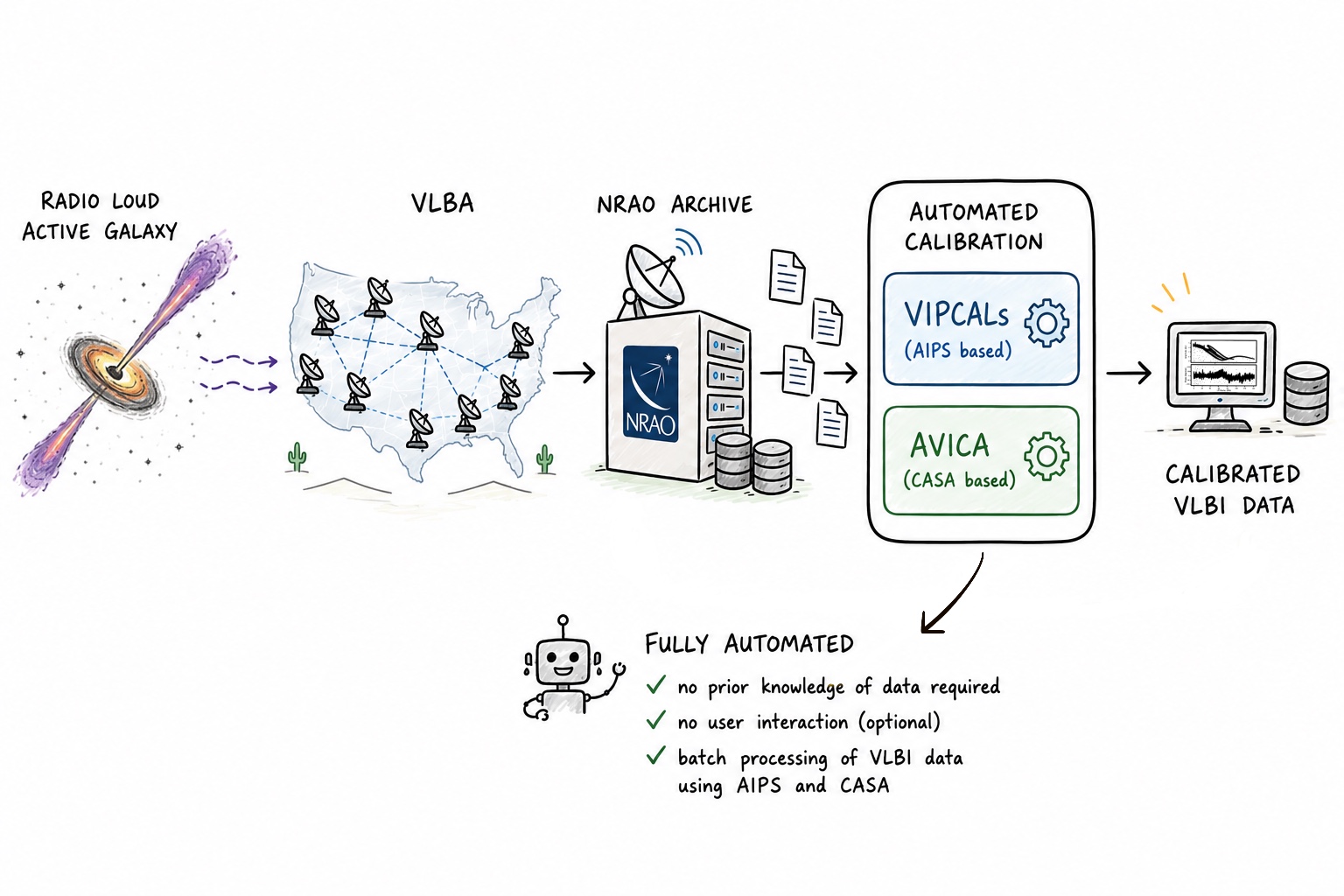
We are excited to introduce VIPCALs, a fully automated calibration pipeline for Very Long Baseline Interferometry (VLBI) data. Developed as part of the SMILE (Search for Milli-Lenses) project, VIPCALs can process thousands of datasets without human intervention. Built on ParselTongue (a Python interface to AIPS), it provides a streamlined interface and delivers fully calibrated datasets ready for scientific analysis. The paper describing VIPCALs is available on arXiv:2508.13282, and the code can be accessed from the GitHub repository.
We are also excited to introduce AVICA, a fully automated CASA-based calibration pipeline developed for the VLBI community. AVICA extends the existing rPICARD calibration framework by automating the preprocessing of the input data, along with the selection of calibrators and reference antennas, enabling blind automated calibration across the heterogeneous data formats, such as those produced by the VLBA over three decades of operations. AVICA is available as a Python package, providing an extensive library for manipulating and inspecting FITS-IDI data. The paper describing AVICA (Kumar et al. 2026) is available here, documentation can be found here, and the code can be accessed from the GitHub repository.